
A year-long quilt project
Welcome to the third step in the 2024 quilt project. (You can find the first one here and the second one here). As I explained in the New Year’s post here, I’ll be making a quilt this year and inviting you to join with me, here on the blog. This is what to expect:
- a new appliqué block each month
- a new embroidery stitch each month
- cheerful bright colours (but of course you can choose your own colour palette!)
- a quilt celebrating the seaside
There will be instructions at the end of the year on how to put the different blocks together to make quilt measuring 72 x 72″. However, you are welcome just make the individual blocks each month and use them in a different way.
Please note: All the instructions are free and available for your personal use. They cannot be used for commercial purposes or for teaching. I do run a small business, so if you enjoy making the quilt please consider also purchasing one of my patterns from the Etsy shop (link below) and/or tell your quilting friends about Amanda Jane Textiles. Thank you!
March block: The Lifebelt
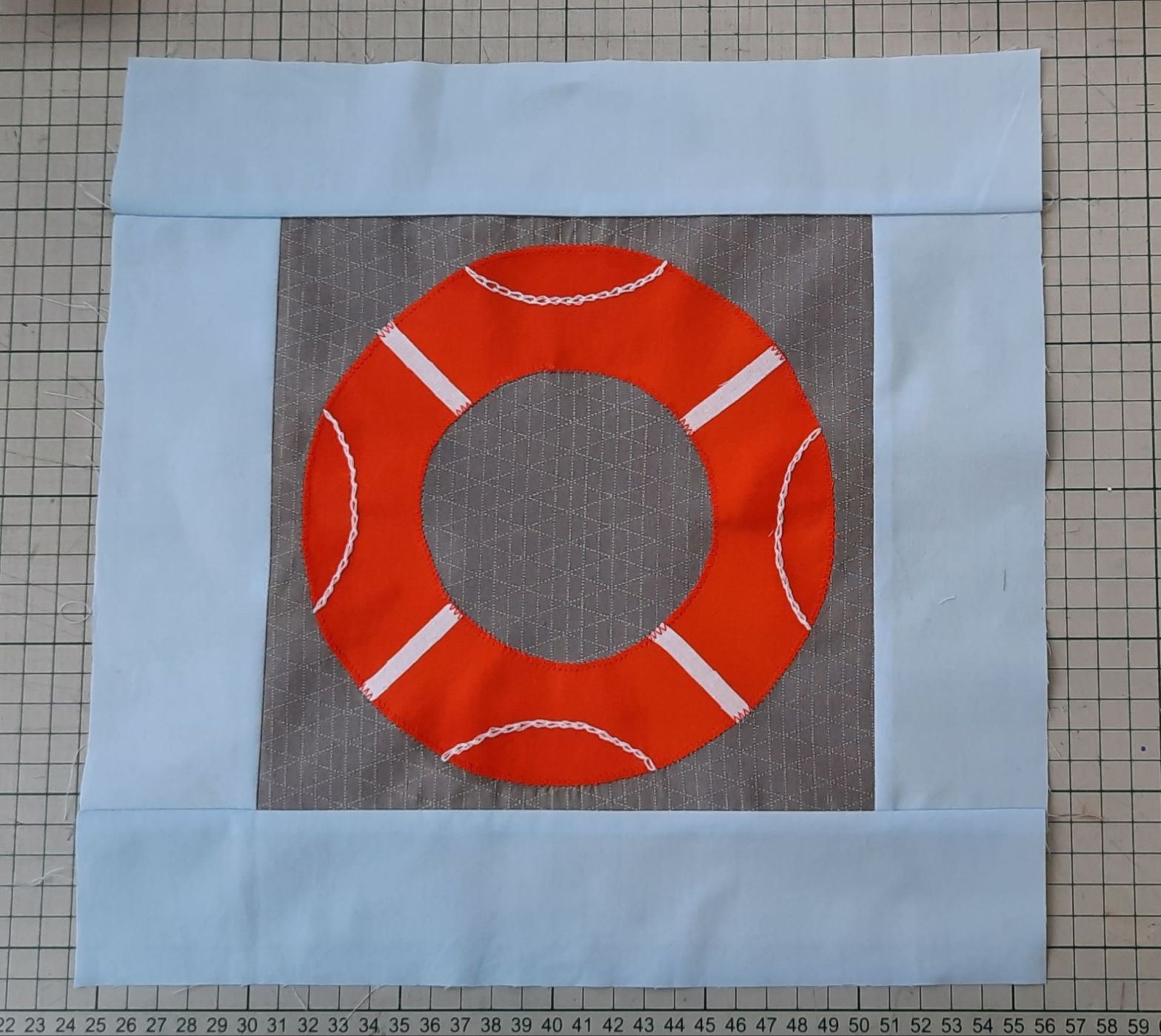
The block is made up of a central panel, featuring an orange lifebelt with white stripes, on a grey background, framed by a pale blue border. The straps are added by adding strips of white fabric. The rope is added by using chain stitch. It measures 12½ x 12½” (12 x 12″ finished in the completed quilt).
Materials
You will need:
solid colours or low-volume prints in 100% cotton fabric: 8 x 8″ orange; 9 x 9″ grey; 3 x 2″ white; 13 x 11″ light blue
stranded cotton for embroidery in white
orange sewing thread for appliqué and pale grey thread for piecing
small piece of fusible web (such as Bondaweb or similar)
Cutting
1 Download the template for the central panel of the block using the pink button below. Set your printer to print at A4/letter with narrow margins. You may lose a little of the image on the sides but the main information will be there.
2 Trace the following shapes onto tracing paper (a) the outline of the outside of the lifebelt (b) the rope (c) the position of the white stripes.
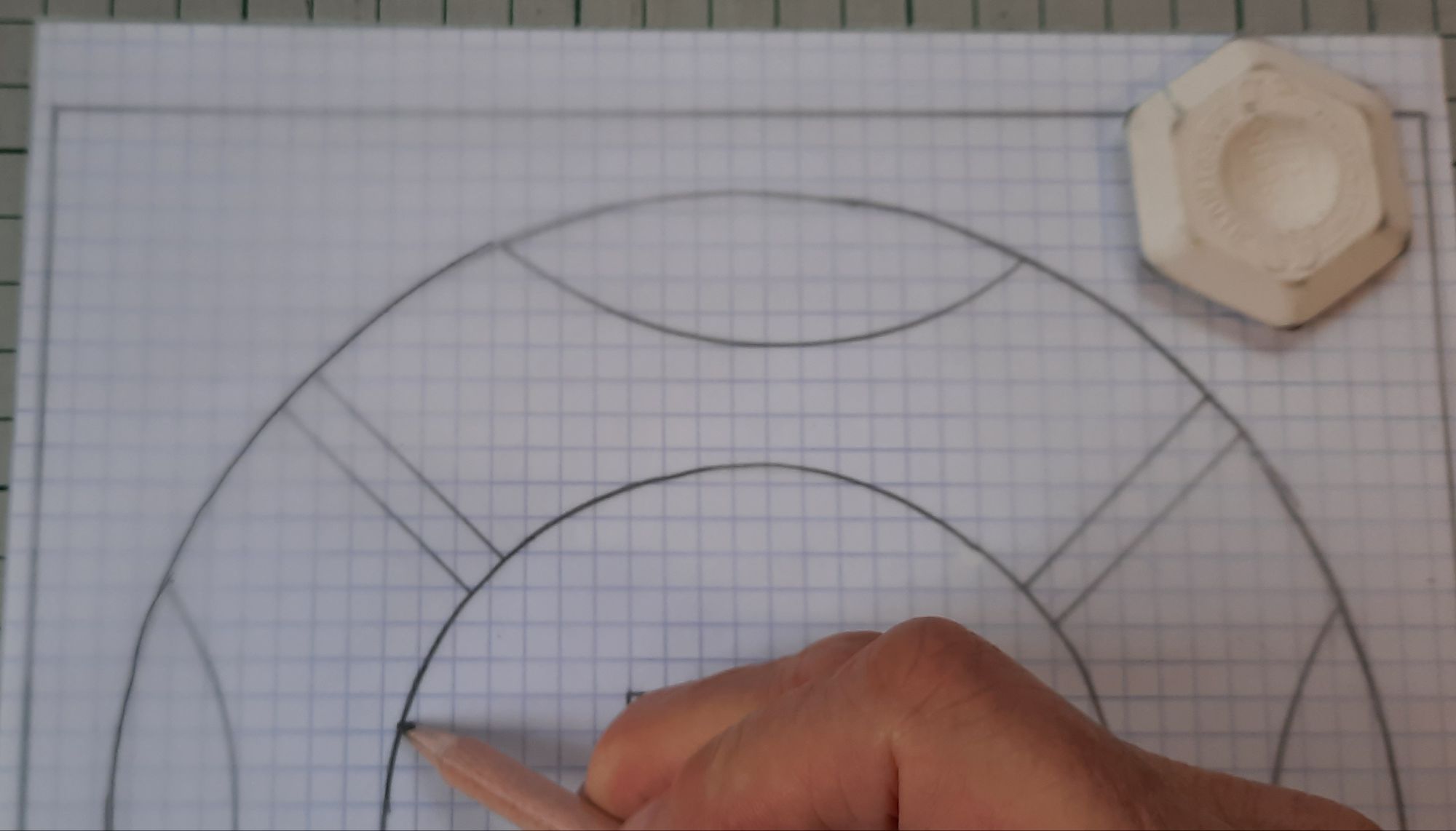
3 From the tracing paper cut out a template for the shape of the belt. Pin it to the orange fabric and cut out.

4 Apply the fusible web according to the maker’s instructions to the wrong side of the white fabric, taking care to protect your iron and your ironing board.
5 From the white fabric, using a rotary cutter, cut four strips ¼ x 1½”.
5 From the blue fabric, cut two border strips 2½ x 8½” and two border strips 2½ x 12½”.
Making the block
1 With the tracing paper template still pinned to the orange belt, bond the white strips to the belt with a hot iron, protecting the board and the work as before. Use your traced template to position them correctly.

2 Pin the orange shape centrally on the grey background fabric. Small appliqué pins are very helpful for holding fabric pieces in place. Start with the centre circle: pin at 12 o’clock (if you imagine a clock face) then 6 o’clock, 3 o’clock and 9 o’clock), then fill in with pins in between.

Don’t pin too close to the edge. Repeat the process round the outside of the belt. (NB the background fabric is slightly larger than the area needed – it will be trimmed later.)
3 With orange thread in your machine and a regular machine foot, set your machine to zigzag, with a stitch width of 3 and a stitch length of 1.5. Stitch around the inside edge. Take the threads to the back and finish them off with a knot. Repeat for the outside edge.
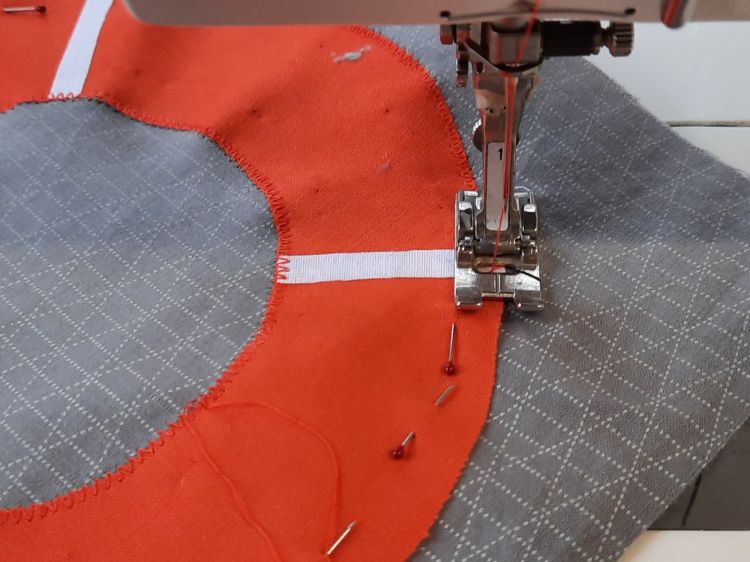
4 Mark the position of the rope around the belt with a water-soluble marker. Cutting the rope shape out of the template makes this easier.

5 Use chain stitch to create the rope. You can see a demonstration of how to do this embroidery stitch on my YouTube channel here.

6 Complete the four sections of rope (see photo below).
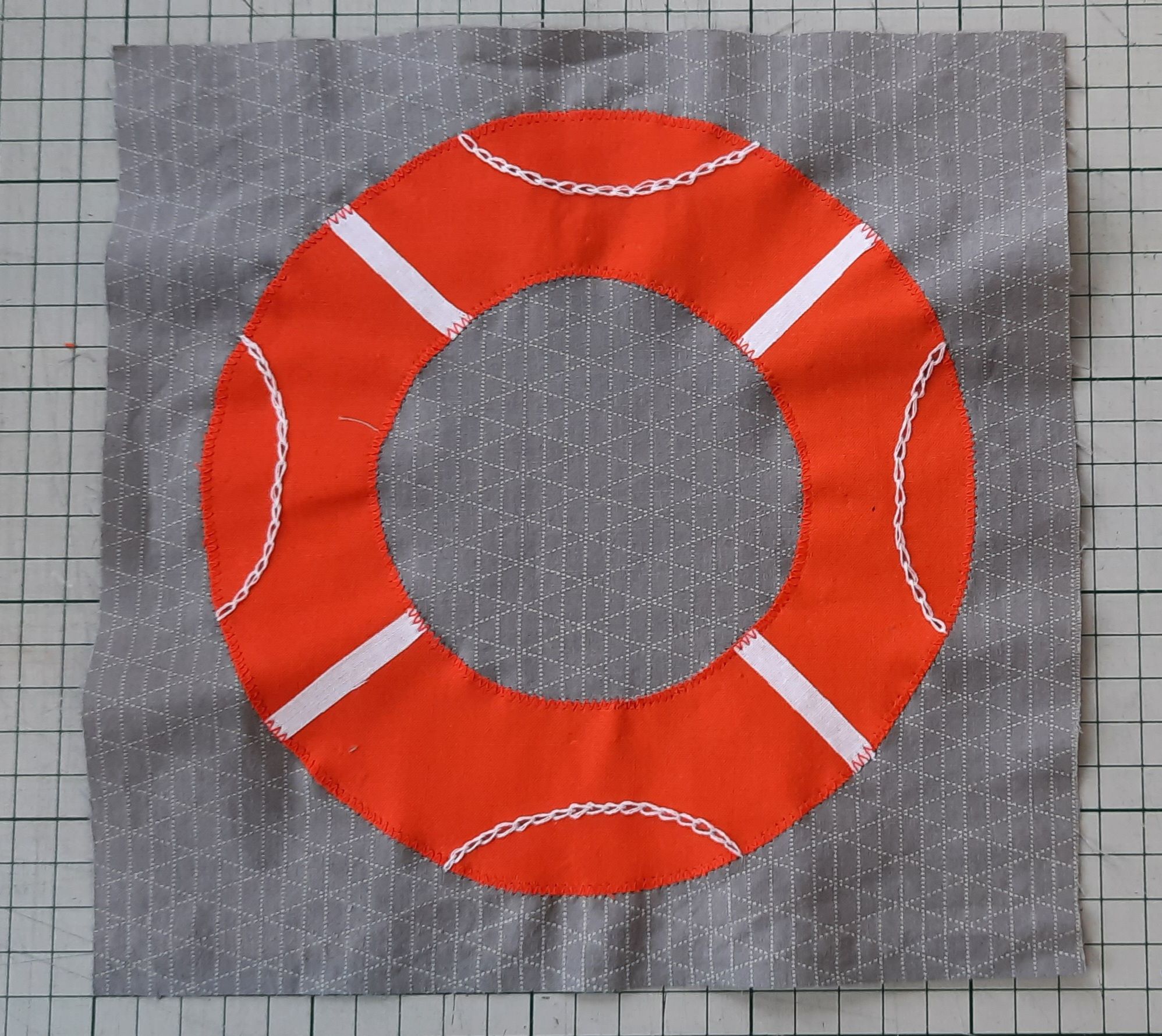
Once the embroidery is complete, dampen those areas to completely remove the markings. Allow the piece to dry out thoroughly before proceeding. (NB if you iron the marks you risk making them permanent!)
7 Trim the rectangle to 8½ x 8½”, making sure that the lifebelt is in the centre.
8 Attach the two blue side borders, pressing the seams outwards. Attach the top and bottom borders, pressing the seams outwards.

9 Press the block from the back (still using the protective paper on the ironing board).
The Lifebelt block is complete. Set it aside and look out for the next block in April!
The colour orange occurs in more than one of my patterns! Both of these patterns work as a baby-quilt, wall-hanging, lap-quilt or play-mat. This is Colour Maze’. It’s available here

This is ‘Here Comes the Sun’. It’s available here

Thank you for reading my blog. Quilt Patterns are here, Fabrics are here, Classes are here
Click the ‘Follow’ button to get a blog-post by email each Monday and click here if you would like the monthly newsletter with design and colour inspiration, etc.
 Amanda Jane Textiles